
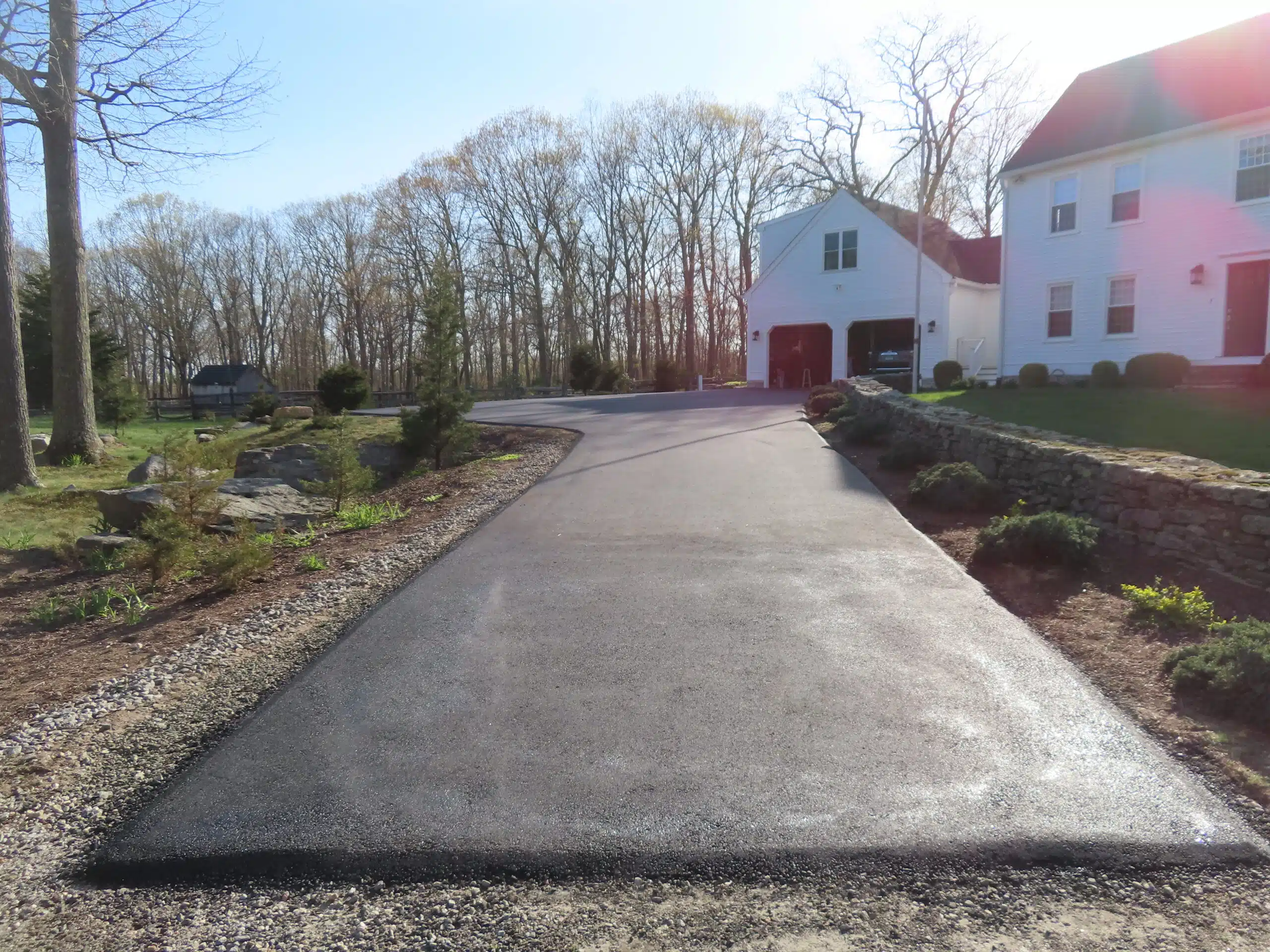
The foundation under an asphalt driveway matters as much as the asphalt itself. Just as a house needs a solid footing, a driveway needs a firm, well-compacted subgrade and a properly built stone base. Get those right and the blacktop has a real chance at a long life: many well-built, well-maintained asphalt driveways last roughly 15 to 30 years, a planning range that depends on construction, drainage, traffic and maintenance, not a guarantee. Get them wrong and no amount of sealcoating will save it. Here's what the foundation does, what a good one looks like in Connecticut, and what to ask before paving begins.
Understanding the Role of the Subgrade and Base
The subgrade and base are the layers beneath the driveway surface. The subgrade may be native soil or engineered fill, and either way it must be stable and well compacted. The base sits directly on the subgrade and is typically processed aggregate such as crushed stone. Together they spread vehicle weight and keep the asphalt from flexing and cracking. How well water drains out of them depends on the materials and the drainage design: a dense-graded processed aggregate isn't automatically a free-draining layer. On a new driveway installation, most of the work you never see happens in these layers.
Stability and Support
A stable, well-built base keeps the driveway from shifting and cracking under load. Crushed stone compacted in layers locks together into a strong platform, which matters most on soft ground or wet sites. The subgrade has to be stable before any base goes on. Soft spots and organic soil generally need to be dug out and replaced, not covered up. Existing fill isn't automatically unsuitable; it should be assessed, and removed or corrected only where it won't provide stable support. And both layers depend on good compaction, just like compacting the asphalt on top.
Load-Bearing Capacity
The base layer of an asphalt driveway has to carry the heaviest vehicle that will use it. For a typical home driveway, a stone base of about 4–6 inches or more after compaction is a common example, deeper on poor soils. That example doesn't establish adequacy for every Connecticut soil, frost condition, or load, and it isn't a complete frost-protection design. The base and subgrade should be assessed for the intended loads and drainage conditions; the required materials, excavation, and compacted thickness depend on what is found. A driveway that sees oil delivery trucks, propane trucks, dumpsters, or construction equipment needs a heavier design than one that only carries family cars, and commercial lots need more still. Tell your contractor about any heavy vehicles before they price the job.
Frost Barrier and Weather Resistance
In colder climates like Connecticut's, the base is a key defense against frost. When fine, frost-susceptible soils under a driveway freeze, they can keep drawing water up from below, and that water builds layers of ice (ice lenses) that grow and push the pavement up, a process called frost heave. That growth is more than the simple expansion of water as it freezes. Frost performance depends on how frost-susceptible the soil is, how much water can reach it, how deep and hard the freezing is, and the drainage design. A properly selected and built base, combined with grading that moves surface water off and away from the driveway, helps keep the layers under the asphalt drier and can reduce freeze–thaw damage, but a stone depth alone doesn't guarantee frost protection. Where water already collects, drainage and grading work should be part of the plan.
Longevity and Maintenance
A well-designed base and properly prepared subgrade extend the life of an asphalt driveway and reduce maintenance. A weak or wet base is one possible cause of potholes and widespread cracking, alongside others such as pavement thickness and repeated loading; an inspection is what identifies which applies. Routine care still matters. We generally recommend resealing a driveway every two to three years, depending on its condition and the sealer used. Sealcoating is a surface treatment that won't restore structural strength, but along with filling small cracks each spring it helps keep water out of the foundation you paid for.
Comparing Contractor Quotes
When evaluating quotes from contractors, look closely at the foundation work. A cheaper quote may skip excavation, use less stone, or leave out compaction steps, and that shows up later as settling, cracking, and early replacement. Ask every bidder to spell out the excavation depth, base material and compacted thickness, and how they'll handle drainage. It's also reasonable to ask how they'll check the subgrade before placing base, such as by inspection and proof-rolling where appropriate. A visual review alone can't determine bearing capacity or reveal every hidden condition, so ask how unexpected soft or wet areas will be handled and priced. Our guide to comparing driveway paving bids walks through what to check line by line.
In Connecticut, also confirm the contractor is registered with the Department of Consumer Protection as a home improvement contractor; you can look up any registration at elicense.ct.gov. State law requires a written home-improvement contract signed by both parties, with start and completion dates and notice of your right to cancel within three business days. Our registration number is CT HIC.0517988.
Conclusion
The foundation of your asphalt driveway is as important as the blacktop itself. Investing in proper subgrade and base preparation pays off in a driveway that stays smooth and solid for years. Choose your contractor carefully, and don't hesitate to ask detailed questions about how they'll prepare the foundation.
Serving Connecticut Paving Customers Since 1967
Maisano Brothers Inc. has served Connecticut paving customers since 1967, working from our yard at 1059 Middletown Avenue in Northford. Our current work includes paving, milling, grading, and reclamation. Before you choose a contractor, get more than one estimate and talk through the base and subgrade work each one plans. When you're ready, call us at (203) 239-5405 or contact us for a free estimate, and we'll walk the site with you.