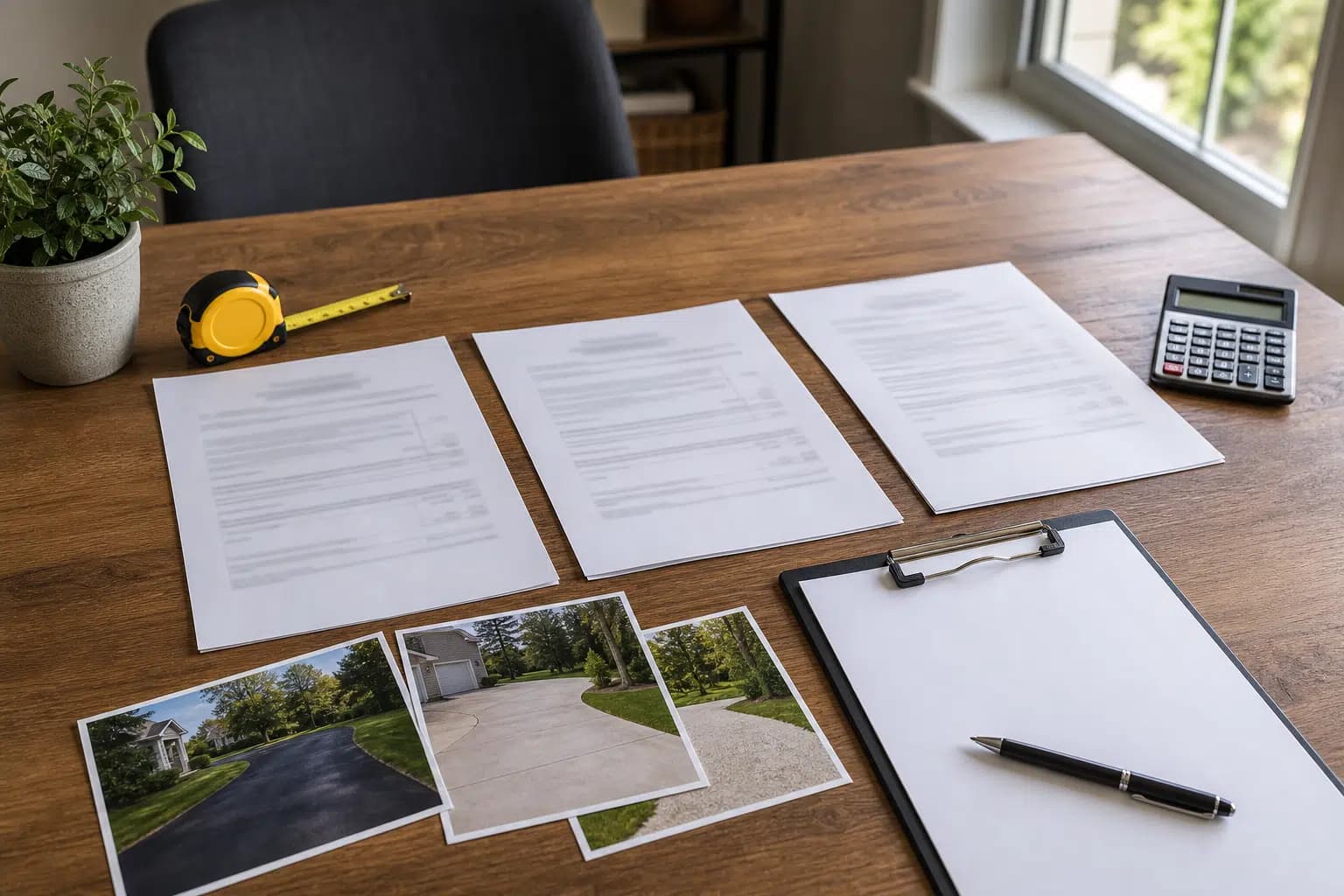
If you have three driveway paving estimates in front of you, the hard part is not finding the cheapest number. It is figuring out whether those numbers describe the same job. One contractor may include removal, base repair and cleanup while another leaves them out. One may state compacted asphalt thickness; another may quote a bare-bones overlay that looks cheaper because it covers less work.
Short answer: compare scope before price. Line up each bid against the same items: measured area, removal and disposal, base assessment and repair, grading and drainage, compacted (not loose) thickness of the base and each asphalt layer, transitions, cleanup, schedule, exclusions, change-order terms, and payment and warranty terms. Where one bid is silent on an item the others include, ask the contractor to price it or confirm it's excluded in writing. Then ask each contractor to explain why their price differs. A low or high price alone doesn't prove a bid is wrong.
Why do driveway paving bids vary so much?
The same driveway can produce very different prices because contractors don't always assume the same conditions. Some inspect the site more carefully, and some include more preparation. Measured quantities, access assumptions, scheduling, insurance and overhead also differ, and a contractor may occasionally underbid and rely on change orders later.
- Site conditions: slope, drainage, soft soil, access, existing pavement condition and driveway length all affect the number.
- Material and thickness: a thicker asphalt section or stronger base costs more and changes how the driveway performs. There's no single right thickness for every site; it depends on loads, soils and drainage.
- Prep work: excavation, hauling, grading, compaction and cleanup are not always included. If they aren't listed, ask before assuming they're part of the job.
HomeGuide notes that driveway estimates should identify excavation, base prep, installation, and cleanup so homeowners can compare offers more accurately: HomeGuide driveway cost guide.

Good bid comparison starts with scope, not the headline price.
How do you compare paving bids side by side?
Use a comparison matrix: one row per scope item, one column per bid. The two bid columns below are a hypothetical example written to show what clear and unclear wording looks like. They are not real bids from any contractor.
| Item to compare | What to look for | Hypothetical Bid A | Hypothetical Bid B |
|---|---|---|---|
| Measured area | Square footage measured on site, with the paved area described | States the measured square footage | "Pave driveway," no area given |
| Demolition and disposal | Whether old pavement is removed and hauled away | Removal and haul-off included | Not mentioned |
| Base assessment and repair | How the base is checked, and how soft areas are repaired and priced | Base proof-checked; soft areas repaired at a stated unit price | Not mentioned |
| Grading and drainage | How the slope will move water away from the house and off the surface | Regrade to direct water to the lawn edge | Not mentioned |
| Mix and specification | The asphalt mix type, where relevant | Mix type named | "Hot asphalt" |
| Thickness | Compacted depth of the base and each asphalt layer, not loose depth as placed | Compacted depth stated for each layer | A single number of inches, compacted or loose not stated |
| Transitions | Tie-ins at the road apron, garage slab and walkways | Apron and garage transitions included | Not mentioned |
| Cleanup | Debris removal and restoration of disturbed edges | Included | Included |
| Schedule and access | Expected timing, how long the driveway is out of use, equipment access | Target window stated | "Weather permitting" |
| Exclusions | A written list of what is not included | Listed | None listed |
| Change orders | How unforeseen conditions are documented, priced and approved in writing | Written approval before extra work | Not mentioned |
| Payment and warranty terms | Deposit, payment schedule, and what the warranty covers and for how long | Schedule and warranty terms written out | Deposit only |
In this hypothetical, Bid B might come in lower simply because it leaves out work Bid A includes, or it might cover the same work and just describe it poorly. You can't tell until you ask. Every "not mentioned" is a question for the contractor, not proof the bid is bad, and the right base work, drainage and thickness for your driveway depend on your site.
The items in this matrix come from the written quote itself. Our checklist of what a driveway paving quote should include explains each one, so you can ask for a revised quote before you compare. For warranty wording, see our guide to what a driveway paving warranty should cover.
What should you ask when one quote is much lower or higher?
A low price doesn't prove poor workmanship, and a high price doesn't prove quality. A big gap is a reason to ask questions.
- Was the work really scoped? A low number may be based on assumptions instead of a careful site review.
- Is the base work thin or missing? If one estimate skips excavation or compaction, it may not belong in the same comparison as the others.
- How will change orders be handled? A low starting price can become a higher final bill if costs are added later. For covered residential work in Connecticut, changes to the contract must be in writing.
- Does the higher bid include more? It may include more excavation, drainage correction or a stronger base, and the contractor should be able to explain the difference clearly.
- Did the contractor look at the site? If they barely looked at the driveway, the bid may be too incomplete to trust. The FTC also advises consumers to get written estimates from several contractors and to get the details in writing before hiring: FTC guidance on avoiding home improvement scams.
Questions to ask every bidder before you decide
- What exactly is included in this price, and what is excluded?
- What is the measured area?
- How thick will the base and each asphalt layer be after compaction?
- How will you handle drainage and the transitions at the road and garage?
- What happens if you uncover a problem after excavation, and how will it be priced?
- Are cleanup and disposal included?
- What are the payment schedule and warranty terms?
If you want a rough budget figure before the bids arrive, our driveway paving cost calculator multiplies the length and width you enter by a generic planning range per square foot for the type of work you choose. It gives a planning range, not a quote, and it does not measure or verify your site. Use it to estimate your area and organize your proposed scope, then confirm quantities and site conditions during each contractor's visit.
From bid to contract
A bid is a pricing document; for covered residential work in Connecticut, the final contract is something more. Before you sign, verify the contractor's current Home Improvement Contractor registration, and make sure the contract is written and signed, contains the entire agreement, includes the registration number, dates and cancellation notice, and puts any changes in writing. Connecticut DCP explains these rules in its home improvement contracts guidance, and our article on whether you need a written contract for driveway paving covers them in more detail. Our guide on how to hire a trustworthy driveway paving contractor covers the rest of the vetting.
What does a clearly scoped job look like?
Scope that names the work makes bids comparable. On this Branford, CT driveway paving project, the scope was milling the existing driveway and then paving it with hot-mix asphalt, and the September 2024 photos show the milled driveway, a truck on the prepared surface and the paver laying the new asphalt. A bid for that kind of job should say whether the old surface is milled, removed or paved over, because each is a different price.
Compare the real job, not the headline number
The best bid is not automatically the lowest or the highest. It's the one that clearly describes the work your site needs. Maisano Brothers Inc. has been paving Connecticut since 1967 (CT HIC.0517988). To get a bid you can compare line by line, request a free written estimate after a site visit.
Frequently asked questions
Should I always get three bids?
There's no requirement to, but three is a practical baseline. It gives you enough comparison without dragging the process out.
Is the cheapest quote ever okay?
Yes, if the scope matches the others line by line and nothing important is missing or excluded.
What if one estimate is much higher than the rest?
Ask why. It may include more prep, drainage work or a stronger base, or a more realistic plan for your site.
What does compacted thickness mean on a bid?
It's the depth of a layer after rolling, which is less than the loose depth as placed. Ask for compacted depths for the base and each asphalt layer so two bids are describing the same thing.
What if two bids look the same?
Then compare warranty terms, change-order terms, communication, recent comparable work, references, and how clearly each contractor explains the scope.