Key Takeaways
- Loose texture, early edge breakdown, early cracking, depressions, and ponding are warning signs that justify a contractor review.
- None of these symptoms proves poor compaction on its own. Density, mix, drainage, pavement thickness, and the supporting soil can all be involved.
- The sooner you document the issue, the easier it is to investigate and address.
A new asphalt driveway should feel solid, look uniform, and hold up to daily use without showing weakness right away. When compaction is done correctly, the mix is dense enough to resist water and early wear. When it is not, or when something else in the construction went wrong, the driveway can start showing problems much sooner than it should.
If you are comparing a fresh driveway to other paving projects you have seen, it helps to know which changes are worth a closer look. Some minor surface changes are normal on new pavement. Others are signs that something in the construction, whether compaction, the mix, the base, or drainage, should be reviewed.
If you are still planning a driveway project, our guide to questions to ask a paving contractor is a better place to start. If the driveway is already showing visible problems, our driveway repair service covers the next step.
Why compaction matters
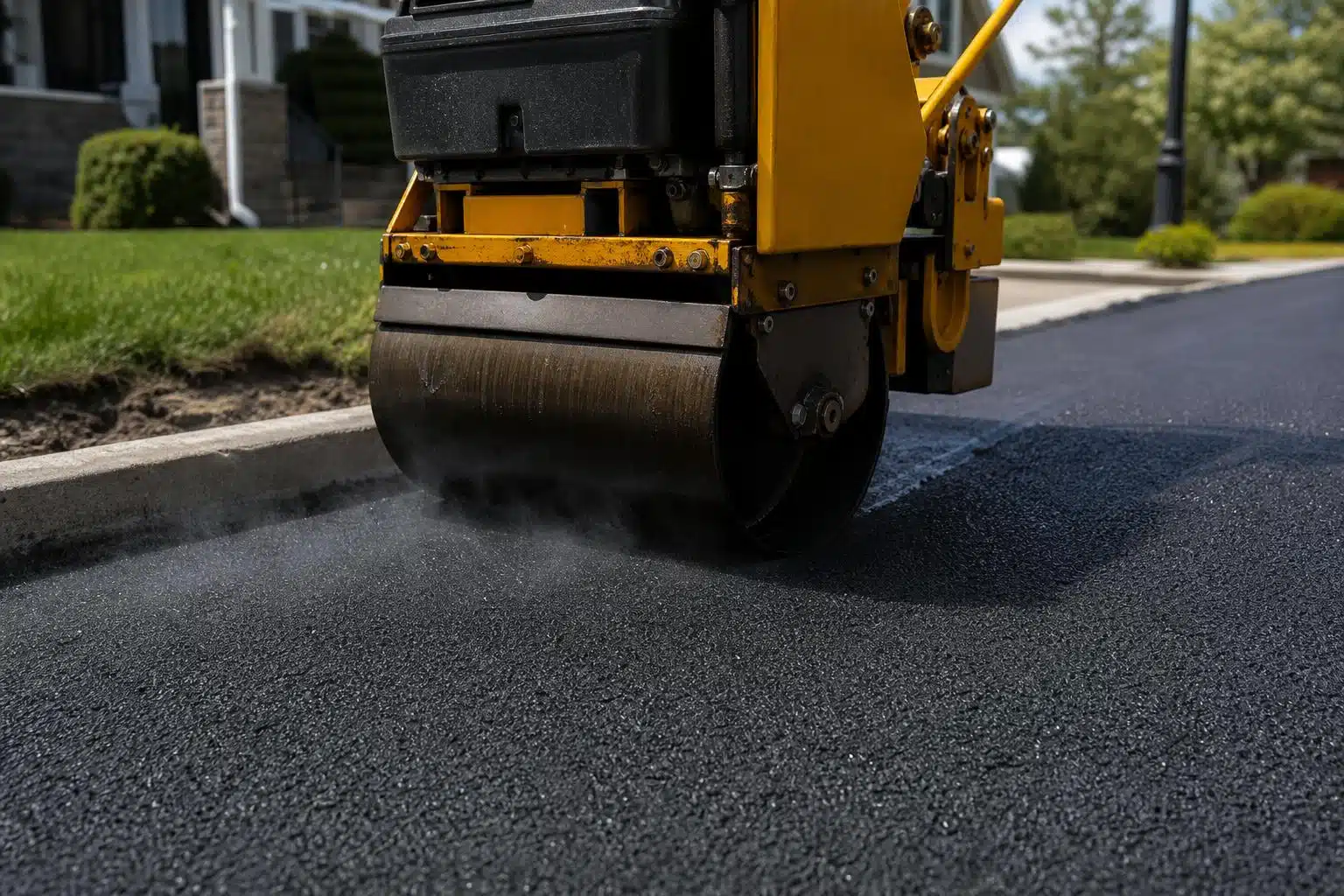
Compaction is one of the most important parts of asphalt installation. Rolling brings the mix to its specified density so the aggregate locks together and the surface can support traffic and weather. The goal is the specified density, not removing every air void; our article on achieving optimal asphalt compaction explains how crews get there.
The Sakai compaction guide explains how temperature, density, and rolling technique affect pavement durability.
The Certified MTP testing guide shows why verification matters when compaction is in question.
Signs that warrant a closer look
Each of the signs below can be associated with poor compaction, but each can also have other causes. Treat them as reasons for an inspection, not as a diagnosis.
1. The surface looks loose or open
A poorly compacted driveway can look rough, sandy, or open in texture. Keep in mind that texture also varies with the mix and aggregate size, so a coarser look is not by itself a density measurement.
That does not mean failure on day one, but it is worth watching closely.
2. The edges break down early
Edges are often the first place problems show up. If the sides of the driveway crumble, chip, or start unraveling soon after installation, the cause may be edge compaction, edge support, or traffic running off the pavement.
3. Small cracks appear too soon
All asphalt can develop cracks eventually, but cracking soon after installation is a warning sign. Low density is one possible cause; pavement thickness, repeated loading, and weak support underneath are others.
4. Soft spots or shallow depressions form
A driveway that shows dips in the wheel path may have a problem in the asphalt itself or in the layers below it. This can be especially noticeable in warm weather or after the driveway has carried a few vehicles.
5. Water lingers longer than it should
If puddles are forming in areas that should drain cleanly, the cause is often grade or settlement rather than the asphalt surface itself. Our guide to why drainage causes pavement failure explains why water that stays on top for too long usually shortens the life of the pavement.
6. The surface starts raveling
Raveling is when small pieces of aggregate start loosening from the surface. That can point to weak compaction, a mix or temperature problem during placement, or a surface that was not finished correctly.
What is normal and what is not
A fresh driveway may look slightly different over its first months. Color can fade, and the surface stiffens as it cools and ages.
That is normal.
What is not normal is a surface that is already breaking down, holding water, or showing depressions very soon after installation. These symptoms justify a contractor review. Determining whether density, mix, drainage, pavement thickness, or supporting soil is responsible may require construction records, measurements, or testing.
If you want to understand early aftercare better, our guide on when you can walk, drive, and park on new asphalt is a useful reference.
What homeowners should do next
If you think the driveway may have a compaction or construction problem:
- take photos of the problem areas
- note when the issues first appeared
- avoid heavy patching before the contractor reviews it
- contact the paving company as soon as possible
- ask whether the issue is related to compaction, the mix, base prep, or drainage
- check what your written contract and warranty say about defects and the claim process
Early documentation matters. The longer you wait, the harder it can be to show when the problem started and what caused it.
How construction problems can be missed
Poor compaction is not always obvious right away. Sometimes it blends in with a normal new surface until traffic, heat, or weather exposes the weak points.
A few common causes of low density include:
- rolling the mat too lightly
- compacting outside the mix’s workable temperature window
- working with a mix that is difficult to densify
- not giving enough attention to edges, joints, or transitions
- rushing the paving sequence
That is why experienced installers pay close attention to the whole process, not just the final appearance.
FAQs
How soon will poor compaction show up?
Sometimes within days or weeks, but other times not until the driveway starts carrying regular traffic.
Can a badly compacted driveway be fixed?
Sometimes, yes. Small areas may be repaired, but more serious failure can require partial or full replacement. The right fix depends on what an inspection finds.
Is soft asphalt always a compaction problem?
No. Heat can temporarily soften asphalt, and a depression can start in the layers below. Repeated softness or visible depressions should be reported so the cause can be assessed.
Should I wait before calling the contractor?
No. If the driveway looks wrong soon after installation, contact them as soon as possible.
Can drainage problems look like compaction problems?
Yes. Ponding can come from grade or settlement, and water management and compaction often overlap, which is why a full site review matters.
What should a good installation look like?
A good driveway should feel firm, drain properly, and show a reasonably uniform surface for the mix that was used. Don't count on every texture difference disappearing as the asphalt ages; ask about anything that concerns you.
Sources
- Sakai America: Basics of Asphalt Compaction
- Certified MTP: Asphalt Compaction Testing Methods
- FHWA: Distress Identification Manual, asphalt-surfaced pavements
Do the signs point to a construction problem?
If your new driveway is already showing signs of trouble, do not wait for it to get worse. Maisano Brothers Inc. can review the surface, explain what we see, and help determine what further checks, repair, or replacement make sense.