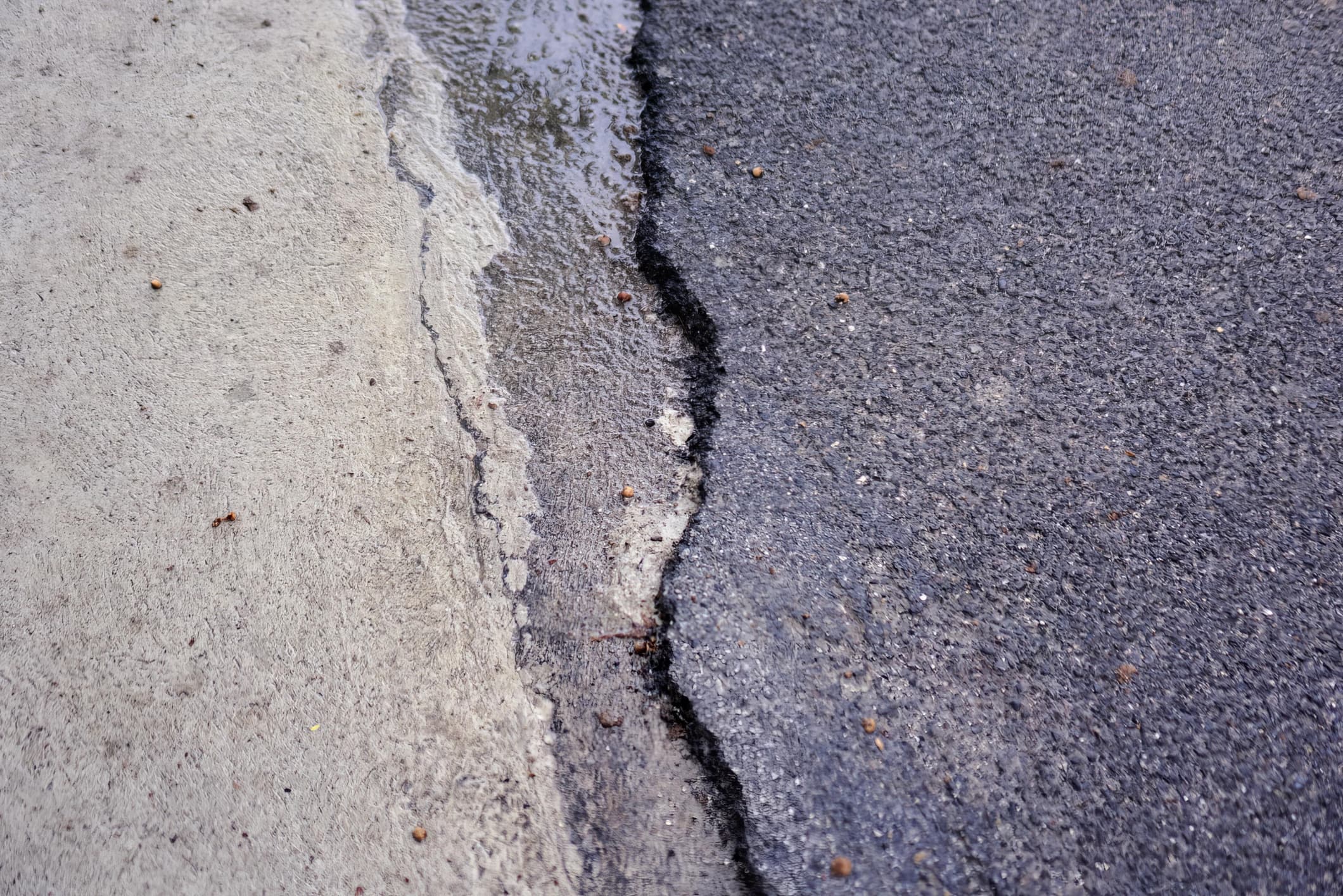
A sunken apron is a section of driveway that has settled below its original level, usually at the street end or right in front of the garage. Possible causes include a base that wasn't compacted well enough, a settling utility trench, water washing out or softening the material underneath, unsuitable fill, or soil settling over time; the cause has to be confirmed on site. The result is a dip or lip that's uncomfortable to drive over, collects water, can be a tripping hazard, and tends to get worse each winter. The fix is to identify why the apron settled, correct the affected support or drainage, and rebuild it to the required grades and transitions so the finished surface directs water as intended. An early assessment helps you understand your options before the problem spreads.
Identifying the Problem
When an apron sinks, it usually leaves a step or gap where it meets the street, the garage slab, or the rest of the driveway. Water runs into that gap and works its way under the pavement, washing out or softening the base and making the sinking worse. Our guide on why the driveway apron matters explains why this section often takes more wear than the rest of the driveway.
Watch for these early signs:
- A bump or dip you feel every time you drive in or out
- Puddles that sit at the street end or in front of the garage after rain
- Cracks running across the apron or along the joint with the street or garage slab
- A visible gap or lip between the apron and the adjoining surface
Causes of a Sunken Apron
A sunken apron has more than one possible cause, and how it looks does not prove which one is at work. A base that wasn't properly compacted when the driveway was built is one possibility. The apron carries every vehicle that enters or leaves, so settlement may become visible there because of turning loads, the transitions at the street and garage, drainage, or weak support. Other parts of a driveway can fail first, so an inspection should identify the cause and whether the problem extends beyond the apron. Trenches dug across the driveway for water, sewer, or utility lines that weren't compacted properly when they were backfilled can also settle over time, and erosion or unsuitable fill under the apron can do the same.
Water makes all of it worse. Poor drainage at the street or a downspout emptying toward the garage softens the base, and Connecticut's freeze–thaw cycles turn that water into ice that lifts the pavement in winter and leaves voids underneath when it melts in spring. If water is the root cause, fixing the drainage and grading matters as much as fixing the pavement.
Steps to Repair a Sunken Apron
- Assessment: Determine how far the sinking extends and why it happened, whether that's base compaction, a utility trench, erosion, unsuitable fill, or drainage. Check the street joint, the garage slab, and the surrounding pavement for cracks, and look at where water is coming from.
- Removal: Saw-cut and remove the sunken section, along with any cracked pavement around it, down to the base.
- Rebuild the base: Dig out soft or contaminated material, replace it with suitable processed stone, and compact it thoroughly in layers. Correcting the support, along with any drainage problem that caused the settlement, is what helps keep the apron from sinking again.
- Repave: Install new hot-mix asphalt, or concrete if that's what the apron is made of, and compact or finish it to the required grades, with smooth transitions to the street, the garage slab, and the rest of the driveway. The target is the designed elevation and slope, not a perfectly flat surface, so the finished apron directs water as intended.
- Cure and protect: Keep traffic off until the new section is ready. For asphalt, our usual guidance, which your crew will confirm for your site, is that it's walkable after about a day and drivable after about three days in mild weather; concrete needs longer to gain strength before it carries cars.
If the apron is at the street, part of it may sit in the town's right-of-way. Requirements vary by town, and many require a permit for work there, so check with your town's public works or engineering department; a contractor who does this work regularly should know the local requirements. For a concrete apron or curb, see our concrete curbing and aprons service; for asphalt, our driveway repair crews handle it.
Preventing Future Problems
A properly designed and well-compacted base, with good drainage, is the best prevention, which is why it should be the first thing you ask about when you get a quote for a new driveway or apron. After that, keep water moving: downspouts directed away from the driveway, edges clear so runoff can escape, and no low spots where puddles sit.
Look at the apron each spring after the frost leaves the ground, when settling and heaving are easiest to spot, and fill any cracks before the next winter. Catching a dip early gives you more options, though the extent of the repair depends on what the assessment finds.
Have a sinking apron at the street or garage? Contact Maisano Brothers Inc. to ask about a free estimate.