
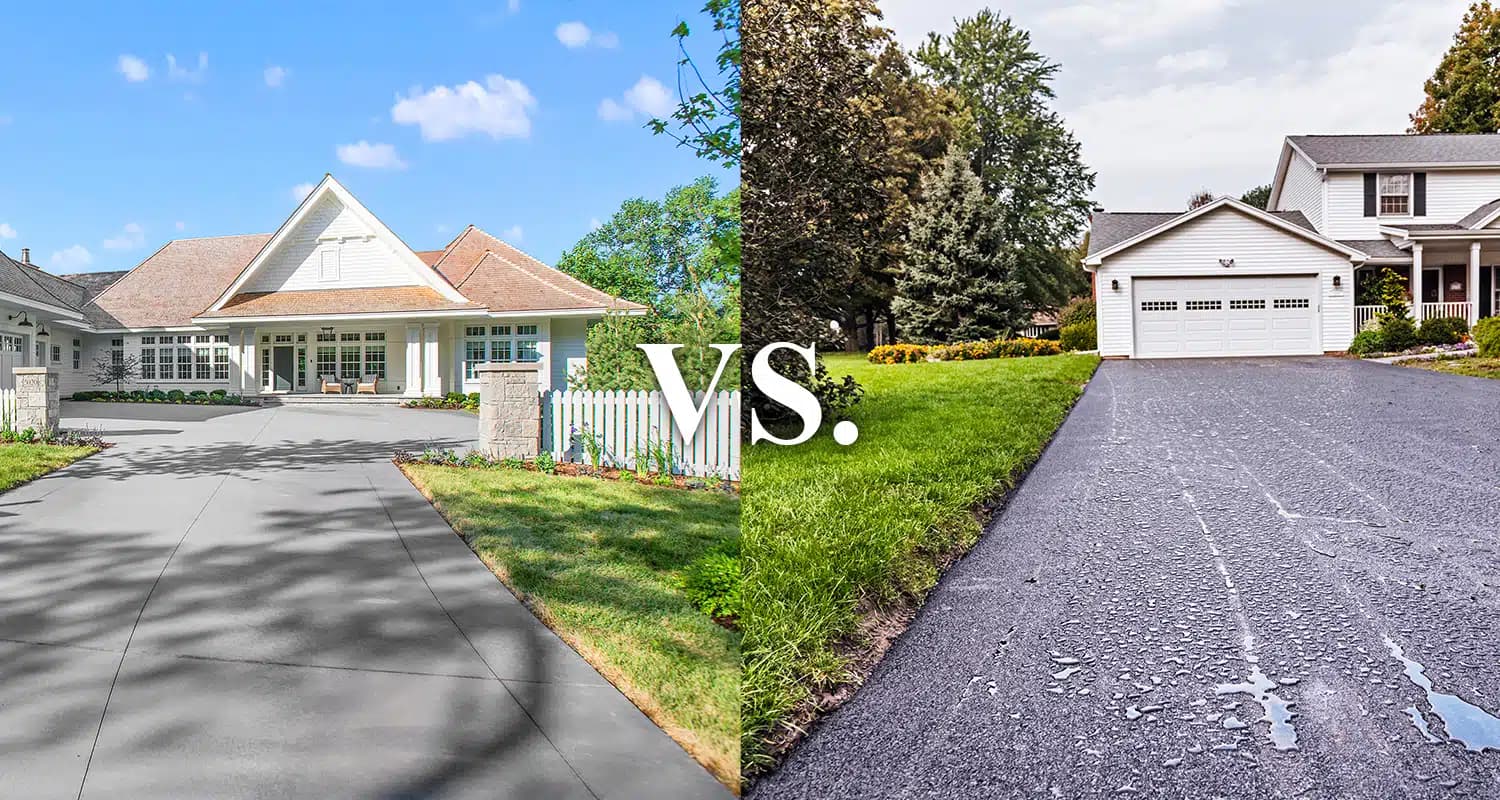
Asphalt and concrete differ in cost, installation time, durability and long-term maintenance. Whether you're replacing a driveway or planning a commercial lot, here's how they compare.
Short answer: both asphalt and concrete can serve residential driveways and heavy-traffic facilities when properly designed. Choose between them using site conditions, loads, budget, maintenance expectations, appearance, and construction constraints. Asphalt usually costs less up front, can be driven on sooner, and is straightforward to repair. Our generic planning ranges (October 2026, not quotes) are about $4–$10 per square foot for a typical new asphalt driveway on a prepared stone base and about $8–$15+ for concrete; excavation, removal and drainage work can move a project within or above those ranges. Concrete usually costs more to install, often lasts longer with less routine upkeep when properly designed, built and maintained, and offers more decorative options.
Key Differences at a Glance
- Cost: Asphalt is usually lower up front; concrete usually costs more to install.
- Installation time: Asphalt is usually paved in a day or two, and in mild weather is usually drivable after about three days. Concrete can take vehicles once it has reached adequate strength under the project's instructions; about a week is a common example, not a guarantee.
- Durability: Asphalt is flexible and tolerates some ground movement. Concrete is rigid and relies on joints and a well-prepared base to control cracking.
- Maintenance: Asphalt maintenance may include crack treatment, localized repairs, and sealcoating when the surface and selected product warrant it. Concrete needs less routine care, but repairs are harder and more visible.
- Aesthetics: Asphalt has a traditional black finish. Concrete offers more colors, textures and patterns.
- Winter performance: Dark asphalt absorbs sunlight, which helps snow and ice melt. Concrete's resistance to deicer scaling depends on its mix, air entrainment, finishing, curing and drainage.
- Best use: Both can serve driveways, roads and commercial lots when properly designed. Concrete pavement is also used for roads and heavy-vehicle applications, not only decorative areas, walkways and patios.
Cost Comparison: Asphalt Usually Costs Less Upfront
If upfront budget is your top concern, asphalt is usually the more affordable choice. Maisano Brothers Inc.'s generic planning ranges are about $4–$10 per square foot for a typical new asphalt driveway on a prepared stone base and about $8–$15+ per square foot for concrete. These are planning ranges, not a quote or a statewide average; final pricing depends on measured area, removal and disposal, drainage, base work, compacted thickness, access and finish. Our Connecticut asphalt driveway cost guide breaks down what drives the price, with a worked example for a driveway of a stated size.
Asphalt's lower upfront cost per square foot matters most on large areas like parking lots, long driveways and private roads. Concrete gets more expensive with decorative finishes, color, stamping or custom scoring. Which material is the better value over its life depends on service life, maintenance and local prices, so compare quotes for the same excavation, base, thickness, drainage, finish and access.
Installation Time: Asphalt Is Usually Faster
A residential asphalt driveway is typically paved in a day or two. It is usually walkable after about a day and drivable after about three days in mild weather; that's our usual guidance, which your crew will confirm for your site. Avoid sharp turns and heavy, concentrated loads on new asphalt, especially in hot weather. Concrete can take cars once it has reached adequate strength under the project's instructions; about a week is a common example. On commercial projects, asphalt's shorter downtime usually means less disruption to business.
In Connecticut, both materials have a season. Asphalt plants and paving crews generally work from about April through November, and concrete shouldn't be poured on frozen ground or when a hard freeze is expected during early curing.
Durability and Performance: It Depends on Design and Site
- Asphalt is flexible, so it tolerates some of the ground movement that comes with Connecticut's freeze–thaw cycles. When cracks do form, they're straightforward to seal or patch.
- Concrete is rigid. On a well-built base it can last a long time, but frost heave and settling can crack slabs, and those cracks are harder to repair invisibly.
Many well-built, well-maintained asphalt driveways last roughly 15 to 30 years; that's a planning range that depends on design, construction, drainage, loads and maintenance, not a guarantee. Concrete driveways often last longer when properly designed, built and maintained. Properly designed concrete pavement also carries heavy vehicles on roads and industrial sites (see the American Cement Association's overview of concrete applications).
Maintenance Requirements
Both materials need upkeep, but the type and frequency differ:
Asphalt Maintenance:
- Sealcoating is optional. Resealing every two to three years is typical guidance, but whether a driveway needs it depends on its condition and the product, so follow the sealer's label. Sealer helps protect the surface from UV and water; it is a surface treatment, not a structural repair.
- Crack filling and patching are relatively easy and inexpensive.
Prompt driveway repair for cracks and potholes, plus driveway sealcoating when the surface warrants it, helps keep an asphalt driveway in good shape for many years.
Concrete Maintenance:
- Less frequent upkeep, though sealing helps protect the surface from salt.
- Repairs are more costly, often visible, and sometimes require replacing a whole slab.
Cold Weather Performance
Asphalt's dark surface absorbs sunlight, which helps snow and ice melt off. It also generally holds up well to road salt, though heavy salting is still hard on any pavement.
Concrete can be used in Connecticut winters. Its resistance to surface scaling from deicing salts and freeze–thaw cycles depends on the mix, air entrainment, finishing, curing, drainage and exposure, and the first winter is when it is most vulnerable (see NRMCA's guidance on scaling). Our Connecticut asphalt vs. concrete driveway guide goes deeper into winter performance.
Aesthetics and Customization
Concrete offers more decorative flexibility: stamped patterns, integral color and exposed-aggregate finishes are all possible, at added cost.
Asphalt is usually a clean black finish, though stamped asphalt and decorative coatings can add pattern and color.
The Final Verdict: Which Is Better?
There's no one-size-fits-all answer. Both can serve driveways and heavy-traffic areas when properly designed. The right choice depends on your site, the loads it will carry, your budget, how much maintenance you're comfortable with and the look you want.
Asphalt may suit you if you:
- Want a lower upfront cost
- Need faster installation and less downtime
- Prefer repairs that are quick and blend in reasonably well
- Are paving a large area where cost per square foot adds up
Concrete may suit you if you:
- Want a decorative finish or a specific color
- Don't mind a higher upfront price and longer wait before use
- Prefer less frequent routine maintenance
- Want a surface that often lasts longer when properly designed, built and maintained
Asphalt driveway work in Connecticut
For an example of asphalt driveway work, see this Middletown, CT residential driveway paving project, whose photos show the paver laying fresh asphalt on a long driveway and the finished black asphalt driveway at a two-car garage.
Need Help Deciding?
Maisano Brothers Inc. has been paving Connecticut since 1967. Ask us about asphalt paving and concrete driveways; we'll look at your site and how you use it, and recommend the best long-term value. Request a free written estimate after a site visit.
Frequently asked questions
Is asphalt cheaper than concrete for a driveway?
Usually, up front. Our generic planning ranges are about $4–$10 per square foot for a typical new asphalt driveway on a prepared stone base and about $8–$15+ per square foot for concrete (October 2026). These are planning ranges, not quotes; compare written estimates for the same scope.
Which lasts longer, asphalt or concrete?
Many well-built, well-maintained asphalt driveways last roughly 15 to 30 years; that's a planning range that depends on design, construction, drainage, loads and maintenance, not a guarantee. Concrete driveways often last longer when properly designed, built and maintained.
How soon can I drive on a new driveway?
New asphalt is usually walkable after about a day and drivable after about three days in mild weather; that's our usual guidance, which your crew confirms for your site. Concrete can take vehicles once it reaches adequate strength under the project's instructions.