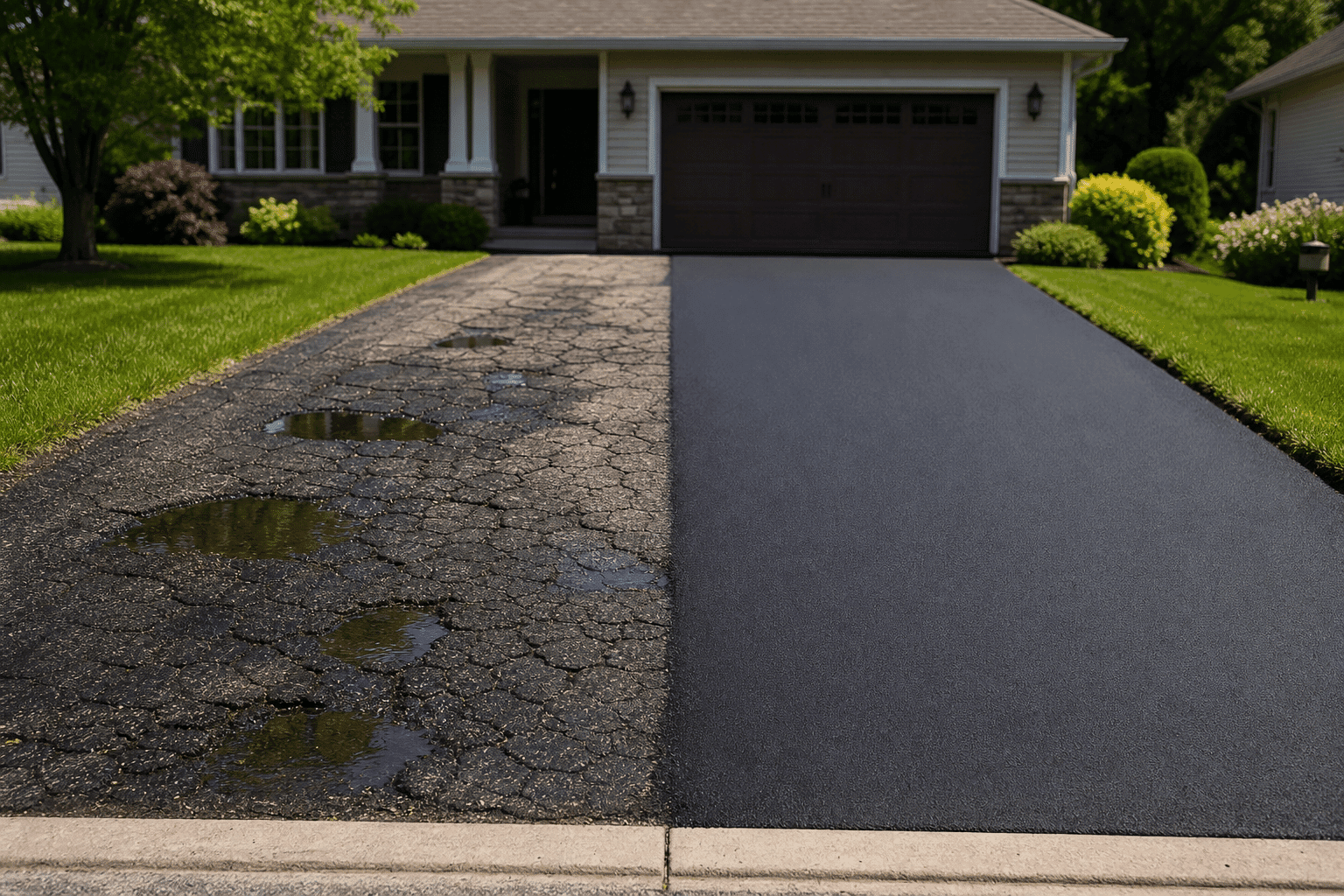
If your driveway is cracked, rough or starting to sink, the real question isn't whether it looks bad. It's whether the damage is still fixable, and with what. Some problems need only maintenance or a targeted repair. Others call for a closer look at the base and drainage before anyone recommends a fix. For a residential driveway, the condition of the pavement and what lies under it matters more than age alone. This guide compares sealcoating, repair, resurfacing and replacement, explains what each one can and can't fix, and covers what an on-site assessment should check.
Short answer: match the fix to the cause. Sealcoating protects a sound surface but doesn't repair anything structural. Crack filling and patching suit isolated damage over a sound base. Resurfacing (an asphalt overlay) can suit a worn surface over a stable base, usually after localized failures are repaired. Replacement is usually the better choice when fatigue cracking is widespread, the driveway has settled or ruts, drainage keeps feeding damage, or patches keep failing. Cracks alone don't tell the whole story; an on-site check of the base, slope and drainage confirms which option fits.
Which fix matches your driveway's condition?
| Option | Conditions it usually suits | What it does not fix |
|---|---|---|
| Sealcoating | A sound driveway with surface fading or light wear; routine maintenance | Cracking from fatigue, settlement, potholes, a weak base or poor drainage |
| Repair (crack filling, patching, full-depth repair) | Narrow or isolated cracks, a small pothole, one failed section | Failure spread across the driveway, or a cause such as drainage that hasn't been corrected |
| Resurfacing (asphalt overlay) | A worn or rough surface over a base that is still stable, with localized failures repaired first | A failed base, widespread settlement, or drainage problems; the overlay inherits them |
| Replacement (reconstruction) | Widespread fatigue cracking, settling or rutting, recurring potholes, repairs that no longer last | Nothing by itself if drainage and base problems aren't corrected as part of the work |
The table is a starting point, not a diagnosis. The same visible crack can come from different causes, and the extent of the damage matters as much as its type. If you're budgeting, our guide to what an asphalt driveway costs in Connecticut gives planning ranges for each of these scopes.
When does a targeted repair make sense?
Repair is the better call when the damage is limited and the structure underneath is still doing its job. A few narrow cracks, a small pothole or a single soft area can often be handled without rebuilding the whole driveway. Filling narrow cracks helps keep water out; a full-depth patch removes failed material in one section and rebuilds it without disturbing the rest. For localized damage, our driveway repair service is usually the first place to start.
Repair is usually the right move when:
- cracks are narrow and isolated
- the surface is mostly level
- water is not pooling in multiple areas
- the driveway is otherwise holding up well
- prior repairs have lasted
Why doesn't sealcoating fix structural failure?
Sealcoating is a thin surface coating. It helps protect the asphalt from water and sun and keeps a sound driveway looking fresh. Resealing every two to three years is typical guidance, though the need depends on the surface's condition and the sealer. But it adds no strength. It can't bridge cracking caused by repeated loads over weak support, lift a settled area, or keep water out of a base that's already saturated from below. Sealing over alligator cracking or soft spots can hide the problem for a season while it keeps getting worse.
That's why driveway sealcoating belongs after the structural problems are repaired, not instead of repairing them.
When is an asphalt overlay a good fit?
An overlay places a new layer of asphalt over the existing pavement. It can give a worn driveway a fresh surface without the cost of a full rebuild, but only when the pavement underneath can support it. Driveway resurfacing is usually a reasonable candidate when:
- the base is stable, with no widespread settlement or soft areas
- cracking is mostly surface-level, or isolated failures can be repaired first
- water drains off the surface rather than pooling
- the added height works at the garage, the road apron and walkways, or the old surface can be milled to keep grades right
An overlay is a poor fit over a failed base. Cracks and movement underneath tend to reflect up through the new surface, so the money buys a new top on the old problem.
When does replacement make sense?
A larger repair or full reconstruction becomes more likely when the driveway is failing over wide areas, not just showing a few bad spots.
Interconnected cracking that looks like a web or fish scales is usually fatigue cracking. It can involve pavement thickness, repeated loading or inadequate support underneath, so appearance alone does not prove the base has failed (see the FHWA Distress Identification Manual). Surface patching or sealing will not correct it. Isolated areas may be candidates for full-depth repair without replacing the entire driveway.
Reconstruction becomes more likely when:
- alligator cracking is widespread, not confined to one area
- potholes keep returning
- the driveway has settled or sunk in spots
- drainage problems keep coming back
- repairs are no longer lasting
- large areas are breaking down at once
Reconstruction costs more because it does more: it removes failed material, rebuilds the base, and gives the contractor a chance to correct drainage and the surface together. When the supporting layers need rebuilding, new asphalt driveway installation makes more sense than more surface fixes. Age is one input, not a deciding rule: an older driveway can still be a good candidate for repair, and a young one can have substantial defects. Even then, an inspection should confirm the cause and extent before you commit to tearing out the whole driveway.

Cracks like these are symptoms. An on-site inspection is needed to tell surface wear from deeper structural problems.
What should an on-site assessment of drainage and the base check?
A good contractor looks past the surface. An assessment should cover:
- Cracking pattern: linear cracks, edge cracks and alligator cracking can have different causes. The pattern is evidence to investigate, not a diagnosis on its own.
- Drainage and slope: where water goes after rain, whether it pools, and whether runoff from roofs, lawns or the road is reaching the pavement.
- Base condition: soft spots, settling and repeated failures in the same place can mean the foundation needs attention before any new asphalt goes down.
- Edges and transitions: breaking edges and failing tie-ins at the garage or road apron.
- Repair history: patches that keep failing warrant a closer look at the repair material and installation, traffic loads, drainage and the supporting layers before choosing the next repair.
If water cannot leave the surface or keeps reaching the base, any fix will break down faster than it should, so drainage correction often has to be part of the plan. The Asphalt Institute's engineering FAQs reinforce that good construction practices and compaction are central to pavement performance: Asphalt Institute technical FAQs. A city pavement preservation program makes a related point: treatments work best before cracking becomes extensive, which is why timing matters (Pavement Preservation Program).
Can an online tool tell you whether to repair or replace?
It can help you think it through. Our repair-or-replace diagnostic asks five quick questions about your driveway's condition and points you toward repair, replacement or an on-site assessment. Treat the result as educational guidance, not a diagnosis. A few answers can't show what's happening in the base or how water moves across your property; only a site visit can confirm that.
Driveway project example
On this Branford, CT driveway paving project, the existing driveway was milled and then repaved with new asphalt. The September 2024 photos show the milled driveway before paving, a truck on the prepared surface, and the paver laying the new asphalt.
Choose the fix that addresses the cause
The best choice is not the cheapest one today; it's the one that deals with the cause so the driveway doesn't fail again next season. Maisano Brothers Inc. has been paving Connecticut since 1967. If you'd like help deciding between repair, resurfacing and replacement, request a free written estimate and we'll assess the surface, base and drainage on site before recommending a fix.
Image credits: featured image and in-body image generated with OpenAI.
Frequently asked questions
Is resurfacing the same as repair?
Not exactly. Resurfacing adds a new layer of asphalt over the existing pavement, while repair fixes a specific damaged area. An overlay only makes sense over a stable base, often after localized repairs.
Will sealcoating fix cracks in my driveway?
No. Sealcoating is a surface treatment that helps protect sound asphalt; it doesn't restore structural strength. Cracks should be filled or repaired first, and widespread fatigue cracking needs an assessment of the base.
How do I know if cracks are bad enough to replace the driveway?
Widespread fatigue cracking, settling, rutting or recurring potholes justify a closer assessment of the pavement and supporting layers. Depending on the extent and cause, the fix may be localized full-depth repair, an overlay after repairs, or complete reconstruction.
Should I keep patching a driveway that keeps failing?
Usually not without finding out why. Repeated failures in the same spot warrant a closer inspection of the repair material and installation, traffic loads, drainage and the supporting layers. The cause is often the base or drainage, and repeated patching can end up costing more than a fix that addresses it.
Can a bad-looking driveway still be repairable?
Yes. Some driveways look rough but still have a solid structure underneath. A site visit is the best way to tell.